
Start a Highland Property Records Search
The free WebGIS viewer is the best first stop. Start there. An address search can point to a mapped parcel and its tax record when the live search exposes that address. Write down the parcel identifier. Add the legal description shown for the selected property. Those details are steadier than a rural street label and bridge you to the Circuit Clerk's grantor and grantee indexes.
Match the record to the question. To see who took title, pull the newest deed and read its parties and legal description. For what the county assessed, use the Commissioner's record; the Treasurer's bill is a separate account. Highland property records describe filed interests, tax administration, and mapped parcels, not a title opinion, a survey, or a sale appraisal.
- Search the Highland WebGIS map with the address or another clue that the live search accepts.
- Copy the parcel number and legal description from the selected parcel, without guessing the county’s APN format.
- Use the grantor and grantee names in Virginia Secure Remote Access (SRA) to find the deed index entry.
- Ask the Commissioner about assessment fields, then contact the Treasurer for a balance or payment status.
- Request a clerk copy or consult the Library of Virginia when an image or older book is not online.
Who Keeps Highland County Property Records
Highland County divides property work by record type. The Circuit Court Clerk records land instruments and keeps related court and fiduciary files. The Commissioner of the Revenue handles real-estate assessment. The Treasurer bills and collects taxes. Building and Zoning deals with permits, plats, and E-911 addresses. These county desks cover parcels inside Monterey too.
Start with the office that controls your fact. The Clerk can identify a recorded instrument and provide a written copy. The Commissioner explains assessment data. The Treasurer verifies a payment or balance. Building and Zoning answers permit, plat-approval, and E-911 questions. A county parcel viewer is a shared starting point, not one database that merges all four records.
Monterey keeps no separate town recorder, assessor, or public permit portal, so the same county offices serve town property. A Monterey postal address may still point to rural land outside the incorporated boundary. Carry the parcel number and legal description between offices, and give each source its own date and record reference so a map result, a bill, and a deed stay distinguishable.
Highland Circuit Court Clerk
165 W Main Street, PO Box 190
Monterey, VA 24465
540-468-2447
Highland Deed Records in Virginia SRA
Virginia SRA is the state access layer for land-record indexes kept by participating circuit clerks. Choose Highland County when offered. Search by grantor, grantee, a recording date range, or a known book, page, or instrument reference. The county collection starts in 1847. The clerk posts no online start year. A missing result therefore proves nothing about whether a deed was recorded.
Index access and document images are separate things. Statewide SRA guidance says index-only access may be free when a clerk enables it. Images can require a clerk-authorized subscriber agreement and payment. The Highland clerk page lists no cutoff or price. The courthouse counter and a written request still work when a record or image does not appear online.
| Search control | What to enter | Highland note |
|---|---|---|
| Locality | Select a court locality | Choose Highland County if enabled |
| Grantor / grantee | Party name | Search both sides when spelling varies |
| Date range | Recording dates | Exact labels and defaults are not published |
| Book, page, or number | Known document reference | Use the reference from a deed or parcel card |
The Virginia SRA land-record portal describes public land records. Its instructions say to sign in before navigating and to sign out when you finish.
Assessment and Bills Have Different Keepers
Assessment and billing sit with different keepers. The Commissioner of the Revenue assesses real estate and maintains the assessment roll. Highland WebGIS is the map route to parcels. Its static page omits some live result fields. The Treasurer handles tax bills, payments, and delinquencies. A value set for tax administration is not the balance due, and neither figure is a market appraisal.
A dated Treasurer notice sets the 2025 deadlines. The first half of real-estate taxes, trash disposal assessments, and emergency medical fees was due June 5. A 2% penalty ran through June 30. A 10% penalty and 10% annual interest began July 1. Treat those terms as the 2025 notice only. For a current bill, balance, or delinquent status, call the Treasurer at 540-468-2265; the county publishes no online account lookup.
Assessment questions go to the Commissioner at 540-468-2142. The office publishes no revaluation calendar, exemption list, or appeal form. Ask about the current review route and deadline instead of carrying a date from another Virginia locality into a Highland case.
Highland WebGIS Starts With the Parcel
Open the Highland WebGIS viewer and an Accept or Decline disclaimer comes up first. Once past it, the toolbar offers About, Layers, Legend, Select Search, Advanced Query, Select Tool, drawing, selection history, Clear All, and Export controls. The map does one job well. It ties an address to a parcel. The address, owner, and parcel fields fill dynamically. Test the live search instead of assuming every key is available.
The viewer posts its own caution. Map accuracy is not guaranteed. A parcel shown on screen never replaces an accurate survey. Treat the layer as a locator, not a legal instrument.
The county's Highland parcel viewer displays the search selector and map tools. It shows where the controls sit before you choose a parcel.
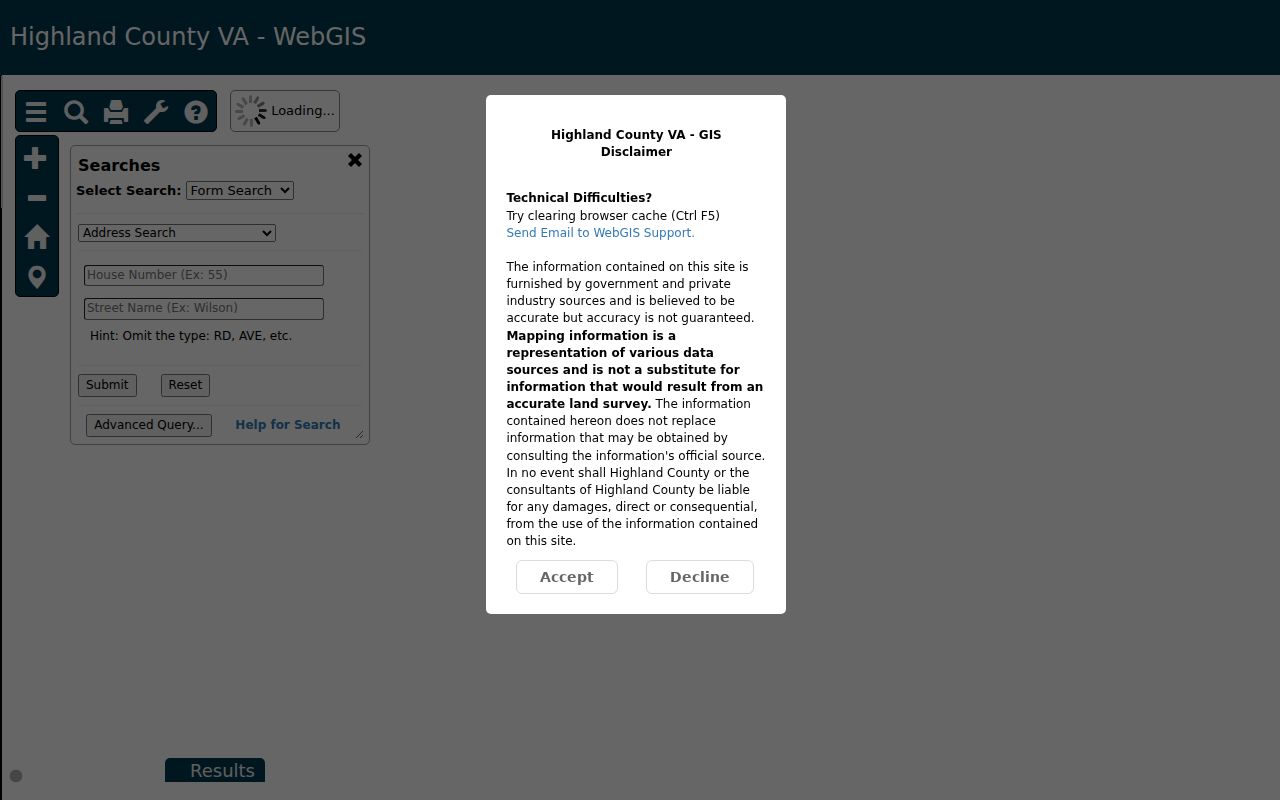
Use the tool controls to select a feature, and export the result if the application allows it. The map helps find a parcel; recorded deeds and surveys answer the legal questions.
Record Types Behind Highland Property Records
Highland property records span deeds, deeds of trust, releases, liens, plats, tax assessments, bills, permit files, and court records. Each set has a different keeper. A GIS feature is a useful index to a place. It is not a substitute for the instrument. That instrument created the interest. According to the Circuit Clerk, county records begin with Highland County's formation in 1847.
| Record Type | What It Documents | Kept By | Access |
|---|---|---|---|
| Deeds and releases | Transfers and other recorded land interests | Circuit Court Clerk | SRA index or clerk copy |
| Deeds of trust and liens | Security interests, claims, and releases | Circuit Court Clerk | Land index and clerk files |
| Assessment roll | Real-estate assessment and parcel traits | Commissioner of the Revenue | WebGIS or office request |
| Tax bills | Amount due, payments, or delinquency | Treasurer | Phone or written request |
| Plats and permits | Subdivision approvals, work, and E-911 addresses | Clerk; Building and Zoning | WebGIS, counter, or FOIA |
For who received title, use the newest deed. The assessment card answers questions of assessed value and parcel characteristics, while the Treasurer holds the tax account. The fuller deed workflow sits on the deed records page, and tax and assessment details belong with the property tax records.
Highland Deeds Reach Back Through Microfilm
Highland County was carved from Bath and Pendleton territory in 1847. The Library of Virginia's Highland finding aid lists Deed Book 1 covering 1847 to 1853. Books 2 and 3 run through 1870, and books 11 and 12 through 1904. General deed indexes include an 1847 to 1902 series plus a grantee index reaching 1981. Confirm the exact reel sequence in the finding aid before ordering.
Clerk records begin in 1847. The public page does not promise that every year is online. If the online system stops returning results, use the clerk's counter or written-copy route. Then check the Library of Virginia microfilm inventory. Reels marked ILL are available through interlibrary loan. Before 1847, a chain of title may run into Bath or Pendleton records. Those jurisdictions supplied the new county's territory.
The LVA finding aid lists deed books and indexes for Highland County. It offers an archival path for when a modern online index does not reach far enough back.
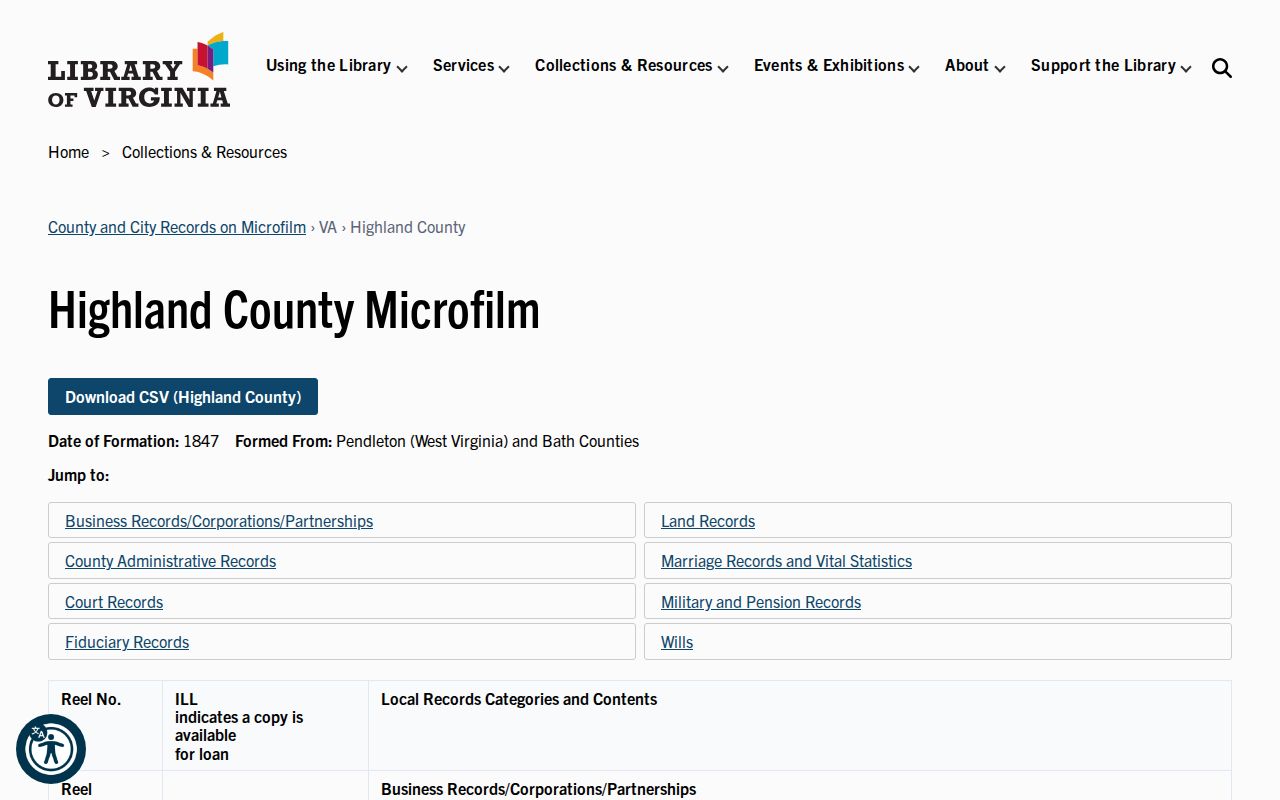
For a very old rural parcel, carry the legal description and names back through each grantor and grantee. Only then switch to a parent county book.
Monterey Mailing Text Is Not a Boundary
Highland has one incorporated town, Monterey, and no incorporated cities. A Monterey postal label can belong to a rural parcel outside the town. The same holds for community and post-office names. These include McDowell, Blue Grass, Mustoe, Head Waters, and Doe Hill. Those names help you search local material. They do not create separate assessor or recorder offices.
Near Monterey, compare the WebGIS parcel and mapped town boundary. Check them against the situs or E-911 address from Building and Zoning. For title, the legal description in the recorded instrument governs. ZIP 24465 is the verified Monterey lead. ZIP 24459 serves the McDowell postal geography. Neither ZIP draws a municipal boundary. USPS lookup can normalize delivery spelling. But it cannot decide which side of the town line holds a property.
The county's Department of Building and Zoning handles permits, plats, land disturbance, erosion and sediment control, and E-911 addresses. It serves property in and around Monterey. Its public page is a contact route, not a town permit database.
Virginia FOIA for Offline Highland Files
When a county record is absent from every public portal, Virginia's Freedom of Information Act offers a request route. The law sits at Va. Code §§2.2-3700 through 2.2-3715. A public body generally answers within five working days with records, a lawful denial, a partial response, or a written explanation and extension. Charges may reflect actual search, review, redaction, duplication, and supply costs. No reason for the request is required.
Highland County directs records questions to the County Administrator's Office at PO Box 130, Monterey, VA 24465, with physical address 165 W Main Street, phone 540-468-2347, email hcboard@highlandcova.org. The county page describes a seven-working-day extension, for a total of twelve working days. Keep the request narrow. Identify the parcel, record type, date range, and desired format. Election records and protected personal details follow separate access limits.
For land instruments, the Circuit Clerk remains the direct custodian. FOIA works well for permit, assessment, retention, or tax-sale material that lacks an online search. It does not replace a clerk's deed index.
The Recorder Began in Monterey in 1877
Monterey gained a lasting voice in 1877, when The Recorder newspaper opened its doors. The state honored that longevity with a historical marker in April 2026. For anyone digging into Highland County property records, the paper is a genuine asset. Its pages carried estate notices, farm and road names, and tax sales. They also carried transfer reports. A terse deed index entry simply will not reveal those.
A newspaper story can explain why a name or event mattered. The recorded deed still stands as the legal proof of a land transfer. The Virginia Newspaper Directory points to repositories with holdings. The Highland County Public Library holds local newspaper microfilm covering 1891 through 1949. Researchers should confirm the run is complete. They should also ask about reader hours. Try pairing a person's name with a clue. A farm, road, or community name works well. Then check the result against the legal description and deed chronology.
The Virginia Department of Historic Resources marker notice documents the Monterey start. It also shows why the paper remains a local-history lead. The marker ties a small-town newspaper to property history. Newspaper notices add texture around a deed record. They never replace it.
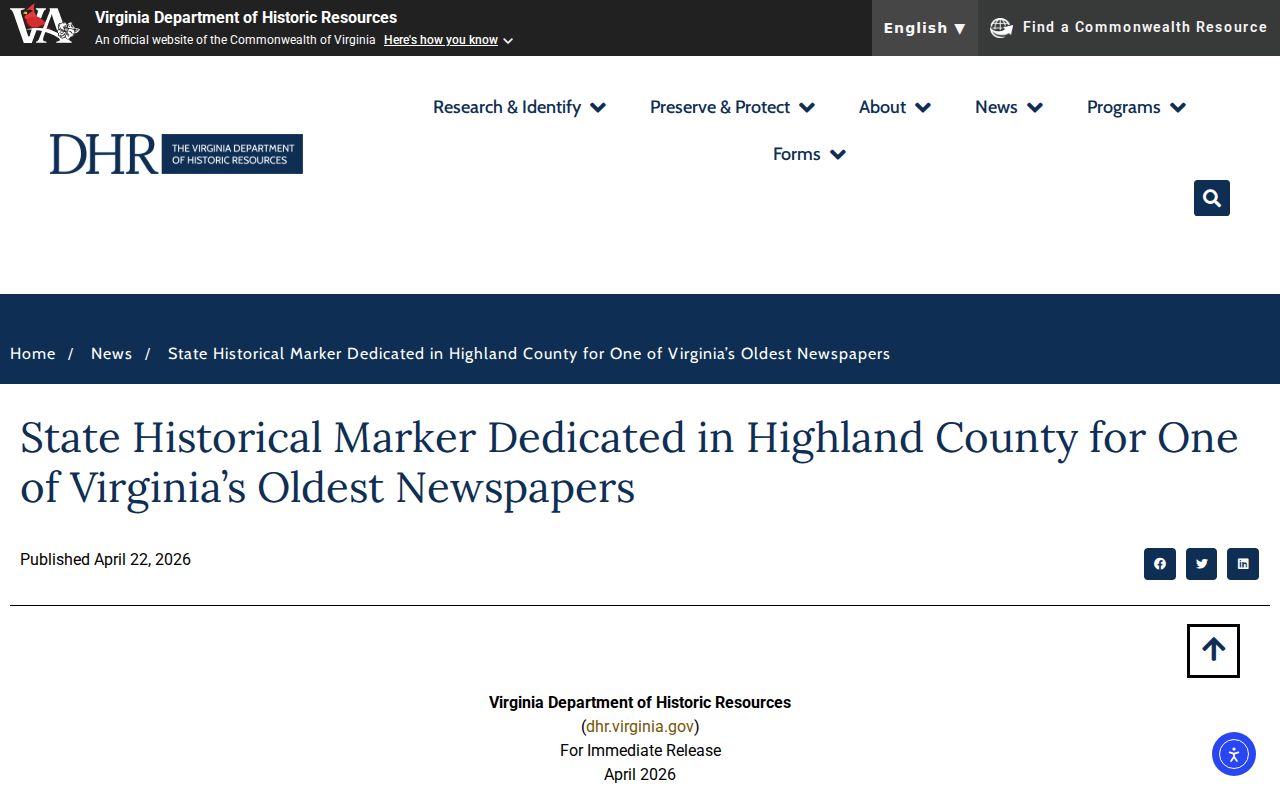
Treat the paper as a lead generator. Then verify every land detail with the Clerk or the archive.
What Highland Property Records Cannot Prove
A Highland County record can prove a deed. It can also prove an assessment, a tax account, a plat, or a permit entry. That is real proof. But records have limits. They cannot guarantee that every private interest was recorded. They cannot guarantee that the current tax roll reflects a fresh transfer. Nor can they guarantee that a mapped parcel line matches a surveyed boundary. Read the instrument itself, and confirm anything important with the office that holds the record.
Lawful use. Highland property records support property research, due diligence, and civic review. A search does not replace a title company or licensed surveyor, and owner details must not be used to stalk, threaten, or harass anyone.
Carry One Parcel Reference Across Highland Offices
Each Highland County office keeps records for its own purpose. So the public systems stay separate. A parcel number and legal description drawn from WebGIS. It can link an assessment card to a deed index entry. That is the thread. The values sit in the map, the Clerk's instrument, and the Treasurer's account. They do not form one synchronized record. Write the source and date beside every copied name, amount, or book reference.
When you ask an office for help, come prepared. Give the parcel location and any known owner spelling. Add the approximate transfer or tax year and the record type you need. A precise request lets staff route the question quickly. It also avoids the false assumption. An address search, tax balance, and deed image do not all sit behind one public screen. The record may not be online. Ask which book, index, reel, or written request procedure applies.